Last week's Art Play session began with a photograph of Finnish artist Heidi Katajamäki with her installation. Heidi's work is a bold example that the 'process' can be the 'product'. Her work is a statement piece, praising the experimental.
I asked the children, 'What do you think about art like this?'
I asked the children, 'What do you think about art like this?'
'Fun', 'messy', 'crazy', they said. 'I want to go there!' said another.
We discussed how the artist has broken some of art's usual 'boundaries', that the art-work doesn't have to 'look like something' or be 'photo-real' to be 'good' or 'worthy'. We noticed that the edge of the paper doesn't necessarily have to be the edge of the painting and that the painting can even drip down onto the floor, all in a bundle.
To create our own 'experimental' work, we started off with a warm-up inspired by 'The Anatomy of a Pencil' at Access Art. Wallpaper lining paper was spread out across the floor in two long rows which would form the landscape on which we were 'taking our pencils on a journey'. The children were told to hold the pencil with two fingers by its very tip and make marks such as 'flick, stroke, flutter, tap, drip, drop'.
Then the pencils were gripped by the fist- 'skid, bore, drill, stir, dig, scrape, mix, drag'. At this point, a few of the pencils were broken. It didn't matter, I had plenty more.
The children were then instructed to drop their pencils, then gently pick them up in a horizontal position. 'relax, gentle, zig-zag, flow, around, melt, curl'
Next the pencils were held as if they were extensions to their own finger. 'dig, poke, bore, relax, line, circles'
As the children got more involved with the activity, their creativity flourished- some children started to work standing up, running the whole length of the paper. One child held several pencils in both hands and skidded across the paper making lovely strong marks. Another jabbed at the paper, making many tiny holes. The paper became smudged, ripped and crumpled. It came alive!
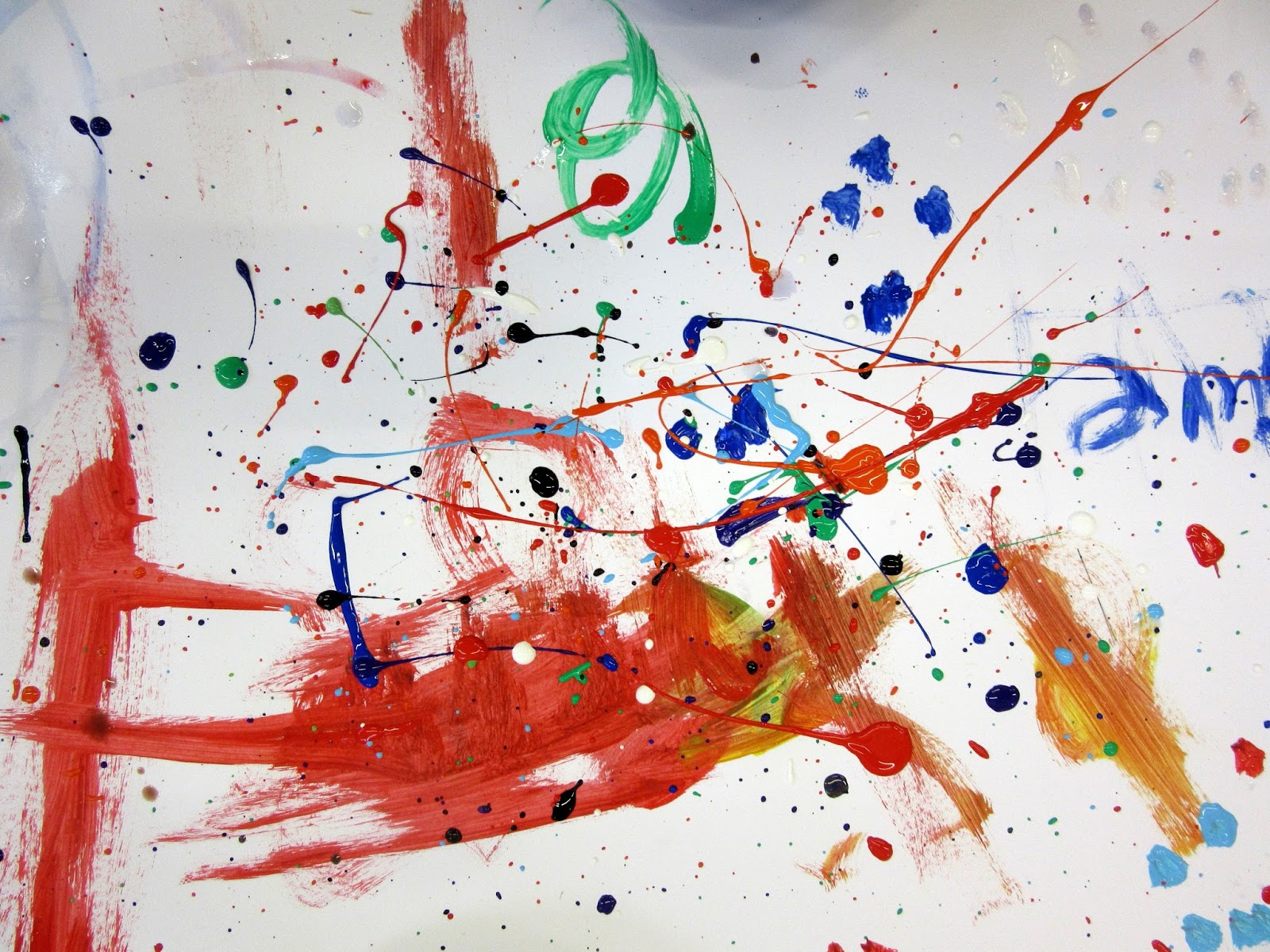
When all the pencils were broken, the children, buzzing with enthusiasm, moved on to the giant white sheet that covered the rest of the hall, on which provocatively lay the 'loose parts' of the day- paper, pastels, brushes, sticks, pine-cones, leaves, water and paint. Like in Katajamaki's installation, the children's work didn't end where the paper did. Paints were mixed, splattered and poured. Different tools made different marks. 'My work is so.... DRAMATIC!' someone cried out. 'At first my work was neat, but then I went CRAZY!' said another. Once child experimented by repeatedly wringing out a wet sponge onto his painting, and then tipping out the whole jar.
You could virtually hear their thought processes. First, there were the 'am I really allowed to do this?' looks, to which I just nodded encouragingly. Then like scientists they experimented, discovered and wondered. The more they realised their sense of freedom, the more they excelled into that elusive creative 'flow' where all the magic occurs.
To create our own 'experimental' work, we started off with a warm-up inspired by 'The Anatomy of a Pencil' at Access Art. Wallpaper lining paper was spread out across the floor in two long rows which would form the landscape on which we were 'taking our pencils on a journey'. The children were told to hold the pencil with two fingers by its very tip and make marks such as 'flick, stroke, flutter, tap, drip, drop'.
Then the pencils were gripped by the fist- 'skid, bore, drill, stir, dig, scrape, mix, drag'. At this point, a few of the pencils were broken. It didn't matter, I had plenty more.
The children were then instructed to drop their pencils, then gently pick them up in a horizontal position. 'relax, gentle, zig-zag, flow, around, melt, curl'
Next the pencils were held as if they were extensions to their own finger. 'dig, poke, bore, relax, line, circles'
As the children got more involved with the activity, their creativity flourished- some children started to work standing up, running the whole length of the paper. One child held several pencils in both hands and skidded across the paper making lovely strong marks. Another jabbed at the paper, making many tiny holes. The paper became smudged, ripped and crumpled. It came alive!
When all the pencils were broken, the children, buzzing with enthusiasm, moved on to the giant white sheet that covered the rest of the hall, on which provocatively lay the 'loose parts' of the day- paper, pastels, brushes, sticks, pine-cones, leaves, water and paint. Like in Katajamaki's installation, the children's work didn't end where the paper did. Paints were mixed, splattered and poured. Different tools made different marks. 'My work is so.... DRAMATIC!' someone cried out. 'At first my work was neat, but then I went CRAZY!' said another. Once child experimented by repeatedly wringing out a wet sponge onto his painting, and then tipping out the whole jar.
You could virtually hear their thought processes. First, there were the 'am I really allowed to do this?' looks, to which I just nodded encouragingly. Then like scientists they experimented, discovered and wondered. The more they realised their sense of freedom, the more they excelled into that elusive creative 'flow' where all the magic occurs.
 |
| Heidi Katajamaki |
 |
| Marks from the warm-up |
 |
| Marks from the warm-up |




 |
| My work is so...DRAMATIC! |


 |
| At first my work was neat, and then I went crazy! |

 |
| The paper is not the edge of the painting |


 |
| What will happen if I tip the all the water on? |
 |
| The children were getting really involved with their work |


